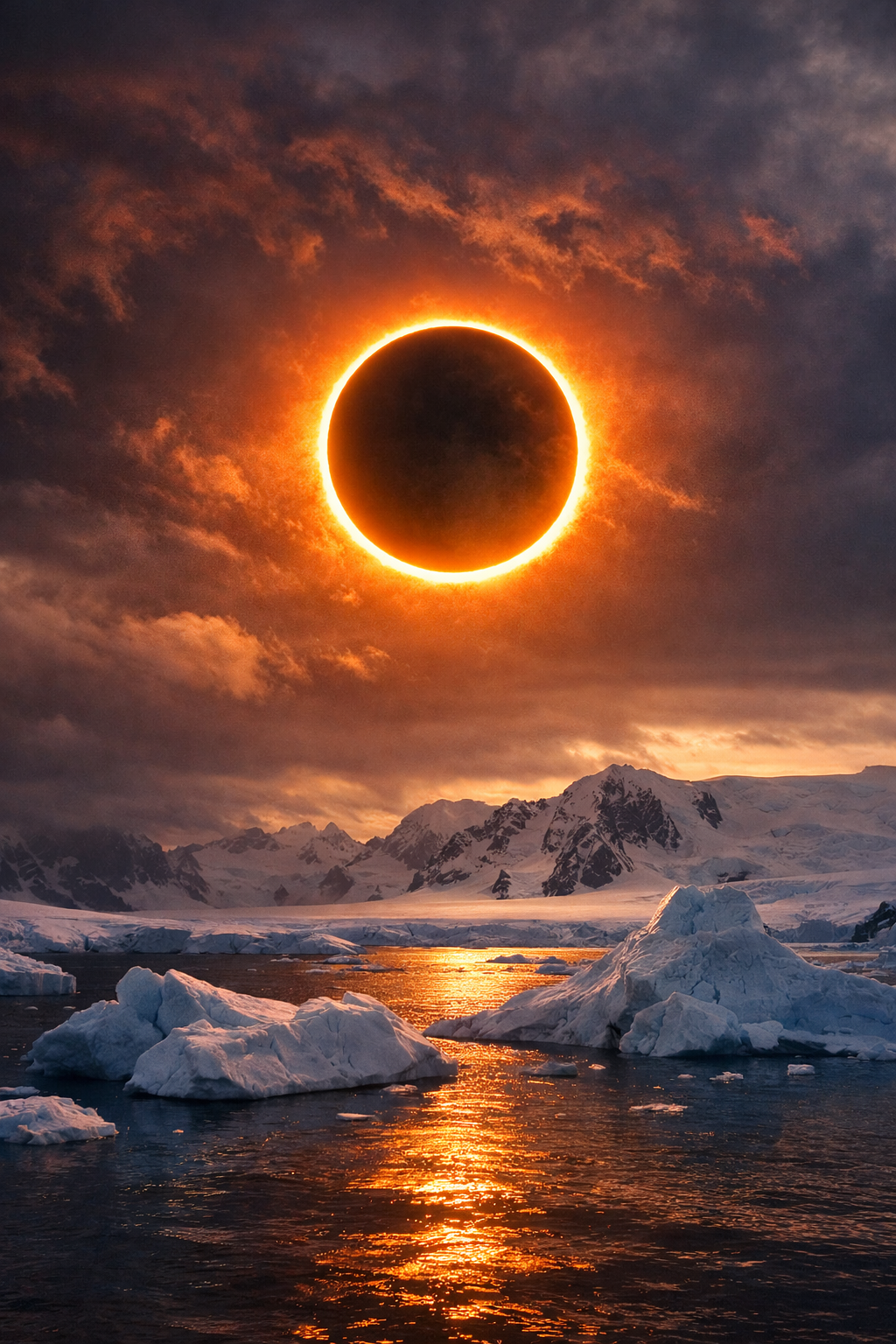
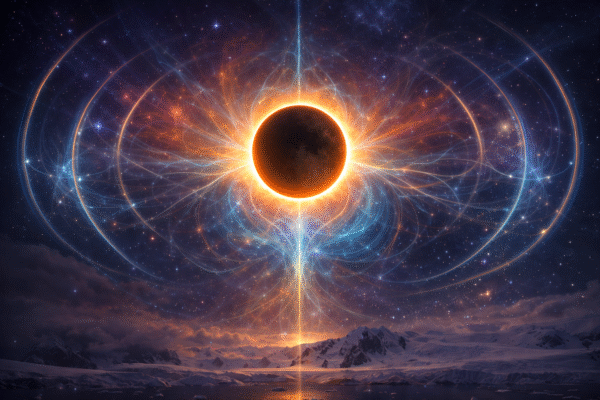
In early 2026, the first solar eclipse of the year will create a striking celestial event: a luminous “Ring of Fire” visible over Antarctica. Known scientifically as an annular solar eclipse, this phenomenon occurs when the Moon passes directly in front of the Sun but does not completely cover it, leaving a radiant ring of sunlight around the lunar silhouette.
While astronomy explains the mechanics with precision, many practitioners of subtle energy sciences including radiesthesia observe such celestial alignments as periods of measurable energetic shifts.
This article explores both perspectives: what astrophysics tells us, and how radiesthetic analysis may interpret the energetic implications.
What Is an Annular Solar Eclipse?
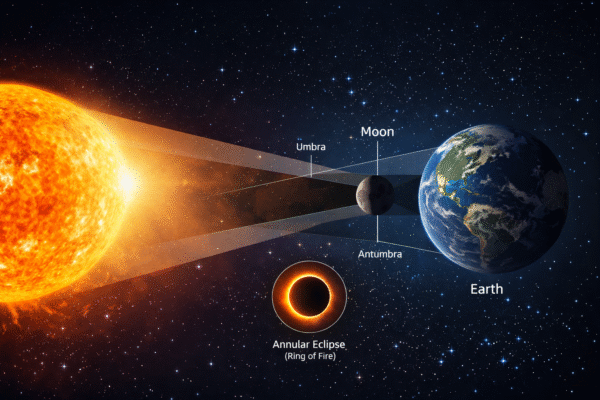
An annular solar eclipse occurs when:
- The Moon is at or near its apogee (its farthest distance from Earth).
- Its apparent size is slightly smaller than the Sun.
- The alignment between Earth, Moon, and Sun is nearly perfect.
Unlike a total solar eclipse, the Sun is never fully obscured. Instead, a bright ring remains visible.
From an astronomical standpoint, this is a predictable and well-calculated orbital alignment governed by celestial mechanics.
According to NASA, an annular solar eclipse occurs when the Moon is at apogee and does not completely cover the Sun.
No supernatural anomaly. No rupture in physics.
Pure orbital geometry.
Why Antarctica?
The visibility path of any eclipse depends on orbital alignment and Earth’s rotation. In 2026, the geometry of the alignment directs the annular phase primarily over parts of Antarctica and surrounding oceanic regions.
Because Antarctica is sparsely populated, this eclipse will be more scientifically observed than popularly experienced.
For researchers, it is an opportunity to:
- Study solar radiation variations.
- Measure atmospheric response.
- Analyze temperature shifts.
- Observe ionospheric fluctuations.
What Does Science Say About Energetic Effects?
From a strictly scientific perspective:
- Eclipses do not emit new forms of radiation.
- There is no evidence of direct psychological or biological disturbance caused by eclipse alignment.
- Gravitational changes during solar eclipses are negligible compared to daily lunar cycles.
However, measurable phenomena do occur:
- Temporary reduction in solar radiation.
- Slight atmospheric cooling in affected areas.
- Subtle ionospheric changes due to altered sunlight exposure.
These are physical, not metaphysical, consequences.
The Radiesthetic Perspective
Radiesthesia approaches celestial events differently.
Rather than focusing solely on physical radiation, radiesthetic practice evaluates:
- Subtle field modulation
- Collective consciousness response
- Geomagnetic interaction patterns
- Biofield fluctuation measurements
Using tools such as pendulums, frequency biometers, and vibrational scales, practitioners may assess whether collective or environmental frequencies shift during astronomical alignments.
From an energetic standpoint, eclipses are often interpreted as:
- Temporary shadow cycles in the collective field
- Moments of recalibration between solar (yang) and lunar (yin) forces
- Periods of heightened introspection in the human energy field
It is not the light reduction alone that is observed but the symbolic and rhythmic interruption of solar continuity.
Measuring Eclipse Influence Through Radiesthesia
Advanced radiesthetic analysis might include:
- Pre-eclipse frequency measurement of a specific location
- Measurement during peak annularity
- Post-eclipse stabilization reading
Practitioners using frequency scales (such as Bovis or other calibrated biometer systems) may compare vibrational variation before and after the event.
It is important to note:
Radiesthesia does not replace astronomy.
It complements observation through subtle perception methodologies.
Antarctica and Geomagnetic Fields
Antarctica holds unique geomagnetic significance:
- Proximity to the South Magnetic Pole
- Strong auroral activity (Aurora Australis)
- Distinctive crustal magnetic anomalies
Some radiesthetic researchers theorize that celestial alignments occurring near geomagnetic poles may produce amplified subtle field variations due to magnetosphere interaction.
While this remains speculative within mainstream science, geomagnetic activity itself is measurable and well-documented.
The interpretative layer is where radiesthesia operates.
Psychological and Collective Field Response
Historically, eclipses have evoked strong emotional and symbolic reactions across cultures.
From a radiesthetic viewpoint, what matters is not the astronomical event alone — but how collective human consciousness interacts with it.
When millions focus attention on a rare event:
- Collective field coherence may fluctuate.
- Emotional resonance can intensify.
- Sensitive individuals may report heightened perception.
These effects stem more from human consciousness than from the eclipse itself.
Is There Any Risk?
Scientifically:
- Only eye damage risk if viewed without proper protection.
Energetically:
- No verified harmful vibrational emission.
- Sensitive individuals may experience temporary emotional introspection or fatigue.
As with any natural cycle, the key is grounding and awareness.
Science and Radiesthesia: Conflict or Complement?
Astronomy describes mechanism.
Radiesthesia explores perception.
Science measures photons, gravitational vectors, and orbital distance.
Radiesthesia measures resonance, vibrational amplitude, and field coherence.
They operate in different epistemological domains.
The 2026 annular eclipse does not demand mystical exaggeration, nor dismissal of subtle inquiry.
It invites observation.
Final Reflection
The “Ring of Fire” over Antarctica in 2026 is a reminder of cosmic precision.
A predictable alignment of celestial bodies and perhaps, for those who observe through subtle instruments, a moment of energetic recalibration.
Whether viewed through telescopes or pendulums, the eclipse represents:
Alignment.
Shadow.
Return of light.
And above all rhythm.